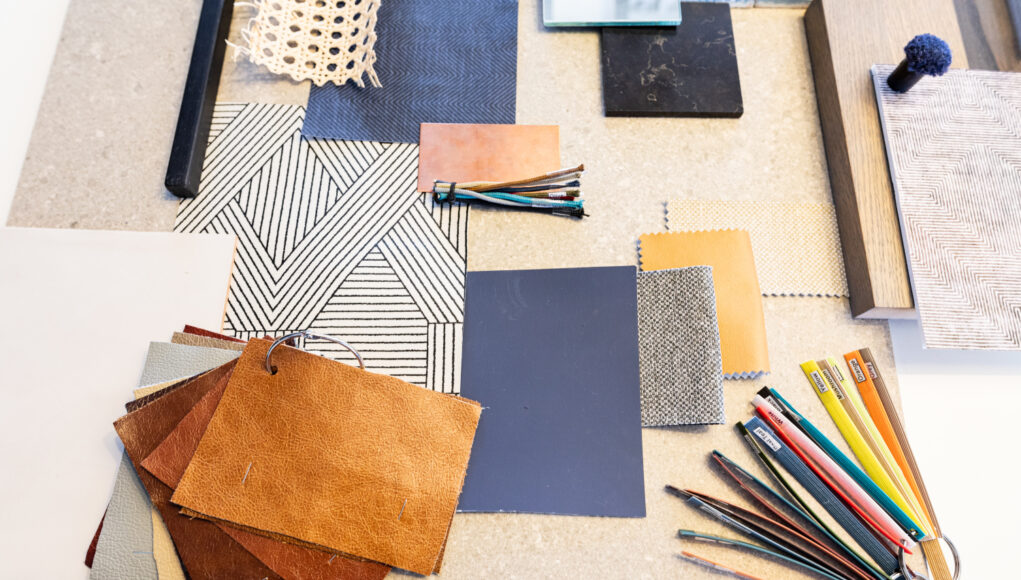
Smart homes were just the beginning. Now the materials in the homes themselves are getting smarter, greener, and more reactive. By 2030, the expectation will be sensory, sustainable, and adaptive design powered by breakthrough material science.
This week, Interior Design 411 explores the materials of the future and what you’ll need to know to start factoring them into your design process now.
Carbon-Neutral Luxury
Sustainability has been a buzzword for years, but by 2030 it will be moving beyond recycled wood panels and bamboo flooring. The next wave of eco-forward materials is redefining what luxury looks and feels like, while outperforming their virgin counterparts. Think leather made from mushroom mycelium that rivals Italian calfskin, algae-based bioplastics replacing acrylics, terrazzo made with crushed e-waste that gleams like semi-precious stone, or hemp composites that outperform traditional MDF in both durability and carbon impact. These materials aren’t fringe anymore. Global manufacturers are already scaling production, and high-end brands are folding them into flagship lines.
Designers will need to rethink the visual language of sustainability. The palette is expanding rapidly, and the finishes are getting more refined. Texture-rich alternatives to stone and leather are emerging that meet hospitality-grade performance standards while being 100% compostable.
The challenge now is less about access and more about knowing which vendors can deliver consistency, performance, and traceable sourcing. Savvy designers should be building direct relationships with material startups and vetted suppliers now. Ask for third-party certifications, and request performance data or mockups before specifying. Attending trade shows with a sustainability focus and subscribing to material innovation platforms can also keep your sourcing future-proof.
Smart Surfaces
Surfaces that change in real time based on environment or user interaction are heading into the mainstream. Thermochromic and photochromic coatings are being reengineered to be more subtle and durable. Embedded sensor arrays are already being integrated into countertops, wall panels, and textiles to track use, adjust lighting conditions, or even optimize acoustics. Expect a future where surfaces will not only support a design narrative but will be interacting with it.
For commercial spaces, especially retail and hospitality, these dynamic materials open new opportunities for storytelling, client engagement, and energy efficiency. Think responsive reception desks that illuminate on approach, or conference rooms with walls that auto-adjust for daylighting. For residential design, especially at the luxury tier, integrated smart textiles are set to become a status symbol, blending tactile appeal with tech-enhanced convenience.
Biofabrication Will Be the New Custom
Mass customization is evolving into material-level customization. With biofabrication, designers are no longer limited to what suppliers offer. Instead, surfaces and textiles can be lab-grown from bacterial cellulose, seaweed, and orange peels with embedded colors, textures, and patterns. Materials can now be tailored to the project from the cellular level up. Companies like Ecovative and Modern Meadow are pioneering platforms where mycelium, collagen, and bacterial cellulose can be directed into specific structural or aesthetic outcomes.
Early adopters are already specifying bio-grown panels that replace traditional upholstery foam or wood veneer. As costs fall, these lab-grown surfaces are set to become standard fare in both residential and commercial interiors. For designers, this means an entirely new layer of control over materiality, opening up storytelling, branding, and spatial narratives that begin at the molecular level.
High-Performance Textiles Will Come With a Conscience
The next generation of performance textiles will be antimicrobial, moisture-regulating, and fully recyclable, without the legacy of PFAS or other harmful chemistries. Fiber innovation is rapidly catching up to climate and health demands, led by a blend of biotech and legacy mills adapting under pressure.
Expect to see more closed-loop fibers derived from textile waste, biodegradable upholstery fabrics that rival polyester in performance, and natural fiber blends engineered to repel allergens and odors without coatings. Contract-grade, sustainable doesn’t mean muted anymore. Rich jewel tones, high luster, and crisp pattern fidelity are fully achievable. Knowing how to specify these responsibly while maintaining aesthetic goals will be a must-have skill in the next few years.
Nano-Tech and 3D Printing Will Blur Material Boundaries
Expect nano-finishes to become a spec standard. These new antimicrobial, smog-eating, or even self-cleaning surfaces go far beyond COVID-era sanitation. They’re also UV-resistant, graffiti-proof, even odor-neutralizing. They’re being applied to everything from upholstery to wall panels to window glass.
By 2030, expect your clients to ask if that velvet banquette is stain-repellent at a molecular level or if the wall paneling actively purifies indoor air. The tech is already being used in hospitals and transit hubs. Residential and hospitality sectors are next.
Meanwhile, 3D printing is evolving from prototyping to large-scale surface production. Imagine custom tilework extruded on-site with embedded texture gradients, or wall panels printed with acoustic absorption tuned to the room’s volume and function.
The convergence of these technologies will allow materials to be performative in ways that used to require mechanical or electrical systems. For interior designers, this brings both opportunity and complexity. Materials are becoming less about what they are and more about what they do. Staying ahead means not just choosing finishes, but orchestrating functions.
Future-Proof Your Material Palette Now
A lot of these materials are still in early adoption. That means due diligence is critical. Ask about lifecycle assessments, scalability, and how materials behave over time. Vet certifications, and partner with vendors who understand interior applications.
More importantly, start experimenting now. By 2030, clients won’t only ask what something looks like, they’ll ask what it’s made of, what it does, and where it goes at end-of-life. The competitive edge won’t be in following trends, but in leading material innovation conversations with confidence and creativity. Use pilot spaces to test next-gen surfaces before rolling them out across full projects. Build your own internal material library of emerging options, and track what actually performs.
The designers who succeed in the next five years will be the ones who learn to work with living walls, smart panels, and textiles that grow in bioreactors. Material fluency is the design edge of the future. What materials are you most excited about?